
Developer Stories: Meet Tami, Software Engineer with a Masters in HR, and Advocate for Minorities in Engineering
Tami graduated with a masters in HR, but has taken a different career path into software engineering. Read her developer stories.
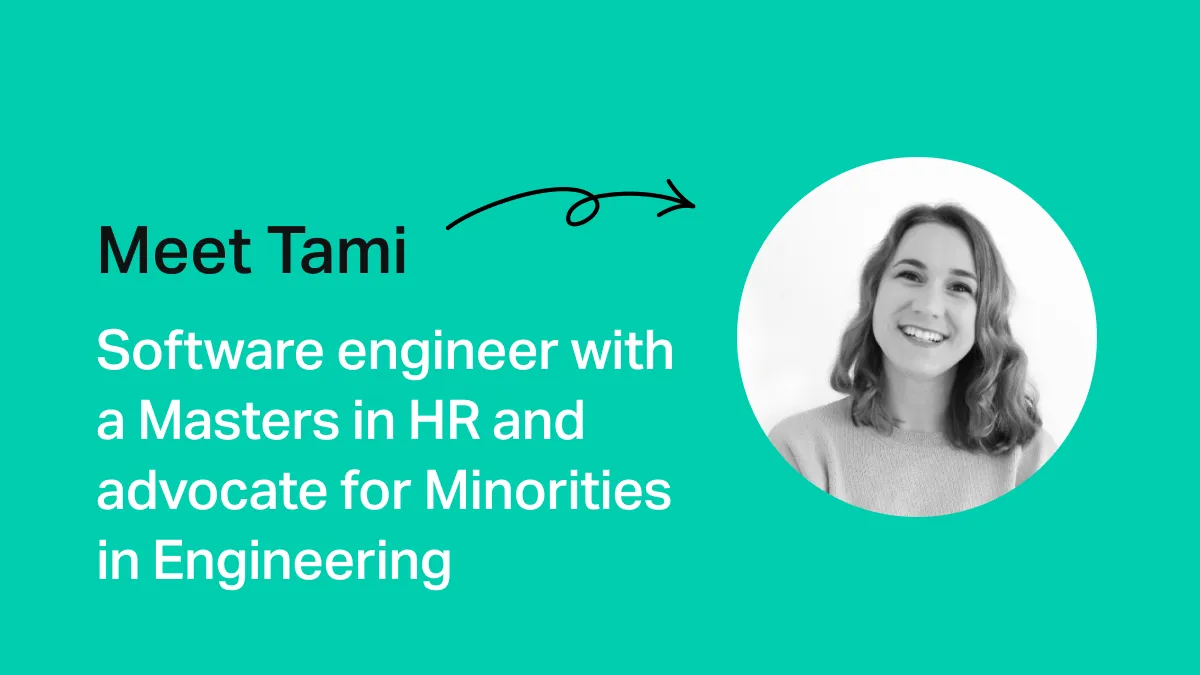
Hi Tami! 😊 Thanks for chatting to us. Fancy kicking us off by introducing yourself and a little bit about your background?
Hey 👋 thanks for having me! I’m originally from a small town in Germany, Cham. It’s in a beautiful area and is part of the Bavarian Forest. After my apprenticeship there, I wanted to do more and moved to a bigger city to catch-up on my A-levels to be able to study Social Work. That’s when I realised I wanted to see more and applied for a masters in Human Resource Management at the University of Edinburgh Business School - thinking that I’ll come back with some more English language skills which will land me a cool job in HR. Things have gone into a very different direction since then and by now I have been in the UK for six years, of which five in London, have changed my career to become a Software Engineer (which I love!) - and have gotten engaged to my partner as well as having the pleasure to become an official ‘cat mum’. Who would have thought all of this when I left the 7000 people town back in 2009 😅.
In your current role, what technologies do you use? Are there any technologies you want to learn in the future?
My current role as a Software Engineer is heavily focused on Front End, and as a team we are using TypeScript and Vue. During the bootcamp and my Junior role I worked with JavaScript and React, also mostly building out the Front End parts.
Technologies are more of a tool that help you to solve problems, so I am not too focused on learning a specific tool, but rather becoming better in understanding, breaking down and solving all sorts of technical problems. This is why I am currently doing the “CS50's Introduction to Computer Science” course - to become a better problem solver and therefore better engineer overall, and will hopefully be able to make more educated decisions on the tools to pick.
In general and long-term I would like to do more Backend and Full-Stack though, as I think that it’s important to understand the ‘bigger picture'.
Tell us about your career change while you were at Avast? How did this come about?
I think that suddenly having been surrounded by all those engineers that seem to love their jobs and get paid to do what they truly enjoy did open my horizon. Back in Germany I didn’t really have the exposure to IT/Engineering as it didn’t seem like a very accessible field - and in the UK I saw all the opportunities that are out there, and how to get into it without the respective university degree (which is something I love about London/UK - and I don’t think this would have been possible like that in Germany).
Additionally, the team at Avast was just great. Everyone was so supportive of the idea and very encouraging of it - and I even heard statements like “I wish I would be that brave” etc.
So that was a super positive experience which in a way pushed me even more to make sure I will reach my new goals. When I resigned I didn’t know that I would end up back there, but I had been in touch with them towards the end of my bootcamp and was offered a Junior role in one of their teams, which shows how much they valued me and the change and that there were no hard feelings at all about having had resigned from the other role initially.
How did you broach the subject with a manager? I imagine there are lots of people in a similar situation! In a role in a company they like, but want to jump into a new field.
Oh I remember having felt so guilty on that day. Knowing that I will have to tell my manager - who was great, and hadn’t been my manager for long at that point - that I am resigning, but that it wasn’t his or the company’s fault, but purely me saying that I don’t want to work in HR anymore.
I think we had our usual 1:1 via video call (he managed me remotely) and I told him about my decision. He took it fairly well though, politely congratulated me on the choice and wished me a lot of success (after asking if there’s anything he could do to change my plans), and jokingly said that I am now “switching from talking to people to talking to computers”.
I think it’s important to be honest and fair. An open communication about the decision and why it is like that, mentioning that it has nothing to do with anything other than a change of interests.
I also offered to try my best to find a replacement and get the handover done to make sure it all will be fine. In general, don’t burn any bridges.
Just be a decent and diligent employee/colleague/team member until the very last day and leave with a great network of people.
Talking about culture and lifestyle generally - how did you find the transition moving from working and living in Germany to the UK?From a working point of view, I always say jokingly, but then in a way not, that I could never work in Germany again.
It’s all very formal, you’d probably have to call your manager “Ms” or “Mr” - or if not your manager, then definitely the C-level staff, and absolutely any external person. I love that in the UK it’s more informal, you call each other by the first name which automatically gets rid of any superficial hierarchical distance.
And as I said before, the fact that I am now a Software Engineer, with a Social Work and HR Management degree - I cannot see this happening in Germany. However, I haven’t lived there for a while, so who knows.
From a living point of view, I am still getting used to some of the differences. I do miss the German healthcare system, but I don’t want to bore anyone with that topic 😅.
Overall I love the more digitised ways of doing things, whether that being any administrative tasks, shopping, etc. It all seems so advanced - also in terms of diets.
The vegan options here are fantastic. And especially in London, there is nothing that you can’t do, which is a great basis for someone like me who needs to know that ‘the sky's the limit’ in a way and that I am not restricted in areas which are important to me.
I hope that all makes sense.
Tell us about MIENG - Minorities in Engineering? What is your vision for the future for this community?I have created MIENG to build a platform for minorities in engineering as there are a lot of women in engineering initiatives (which are definitely needed and is something to celebrate - thank you so much to everyone who is driving this forward!!), but there are not just women that need better support and inclusion in the big world of tech. There are many non-binary people, and people from different racial backgrounds, and people with disabilities, and people from less fortunate socio-economical backgrounds who would also benefit from the exposure, network, resources and support. My vision is to create this space which gives everyone the chance to have the career and life they want to by sharing their profiles and some resources. LinkedIn is such a fast-paced platform where a single Like or Comment can help to spread the word within a couple of minutes. Utilising this power would be great - and if even one person would come out of this saying “Someone saw my profile on MIENG and I got the offer for the role I’ve always wanted”, even just one person, that’d be the best outcome I could wish for. Additionally, if companies/decision makers read the posts and take one or two things that the people share about diversity and inclusion on board and change something in their workplace, that’d be the dream. Because who would know better than the people that are the ones you’re trying to include.
What are some of your favourite things about working as a developer, and your least favourite?
With my favourite things about it, I don’t even know where to begin. I just love it. Not too long ago I shared a tweet saying how privileged I feel about being able to earn money with something I just love doing anyway. I like solving problems, I like coding, I like how flexible it all is and that all you need in order to do your job is a laptop and internet connection. I like how rewarding it is and that you just keep on learning. It’s such a measurable and objective outcome - if you learn and understand something, you’ll be able to apply it and get better at what you’re doing. I like how challenging it is, but at the same time that everything is possible. And I like that it’s a skillset that truly opens all the doors for you in the digital world. Oh, and last but not least: I like how I can just be myself. I don’t really have any ‘least favourite’ aspects though. That’s boring, I know, sorry! 😅
How was your experience of finding your current role, how did you come across it and what was the interview process like?
For my current role I was approached by the internal recruiter at that time. He made me curious about it - I had never heard of the company before - and I was willing to give the process a go. And everything sounded so good and I was like “Wow, I didn’t expect that at all!”, so that I found myself becoming really interested in it.I was talking to the recruiter, the CPO, did a tech test and tech interview where I met people from the team and was then giving them the feedback that I really enjoyed the process. Seeing that I am part of the team now, I guess the positive impression was on both sides, and I haven’t looked back since. The process is quite different now as we’re growing so fast and have a dedicated talent team to bring amazing people on board.
Did your HR background come in handy when you were interviewing? How did these skills help or hinder you?
I remember having put a lot of effort into the design of my CV as I thought that the person sitting on the other side and looking through CVs that all look pretty much the same might appreciate a different style. So that’s something I can give as a tip: Yes, skills matter, but imagine candidates having the exact same skillset, and the exact same CV on white paper and normal small fonts, and then there’s your CV, colourful, modern and just different - which one might get a little bit more of the attention?
😊Oh and I remembered that when I sat in interviews and had candidates that just didn’t seem overly interested and had almost no questions about the company or team etc., that this in particular came across very negatively to me when I worked in HR.
So I made sure to write down all the questions about everything that genuinely interested me about the role, culture, company - just so that I wouldn’t forget them with all the nervousness. Which might have helped too.
Additionally to those two points that I was aware of from my time in HR, I was just being myself and honest - as in the end you want to work in a place that hires you for the real you and not for someone you pretended to be during an interview.
What about outside of work - we always like to get to know people rather than just their job titles and their roles. Where can you be found at the weekend or in the evenings?
My two biggest passions are music and games. Pre-covid you would have found me at concerts, gigs and festivals - and I can’t wait to go back to those times. Singing and dancing is something that really fulfills me in my personal life. Apart from that, I love board games, card games and interactive games (escape rooms, mini golf, anything that’s fun really, with a nice mix of competition - even when I lose 😆). And due to recent events, you would also find me doing a lot of wedding research and planning - but that won’t be my activity forever, even though I am sure I’ll find other things to plan! Also, I love being at the seaside - which is definitely easier for me now being in London compared to back home in Germany (even though skiing is something I really miss!).Thanks for chatting with us today Tami!
You can follow Tami on Twitter, connect on LinkedIn and follow MIENG - Minorities in Engineering on LinkedIn too.